
Author
Pixels Mark
Release
Intensity
26 MIN READ
Book cover design costs vary widely because different quotes cover genuinely different things. Some DIY tools are free; others operate on a subscription model. Premade covers from specialist providers such as DesignDusk start from around $25, with prices varying by design and package. For professional custom design, Reedsy's analysis of its curated freelancer marketplace, covering projects completed in 2025, found an average cost of $880, with most projects between $625 and $1,250. These figures reflect different types of engagements at different scopes; they cannot be compared directly.
Before comparing two quotes side by side, understand what each one includes. Two prices can look very different and still represent fair value for their respective scopes.
Pixels Mark offers a free-to-start Book Cover Maker for authors who want to explore a direction themselves, alongside professional book-cover design packages starting at $149.
A Note on Comparing Quotes
Most pricing guides compare numbers. This one compares scope.
A designer charging $400 and a studio charging $1,200 may appear to be selling the same thing. In practice, one might include an ebook front cover and one round of feedback, while the other includes multiple initial concepts, a full print wrap with spine and back, several revision rounds, source files and format-specific delivery for KDP paperback and ebook simultaneously. Those are different engagements at different price points, and comparing their headline numbers directly is not useful.
The questions to ask are: What formats does the quote cover? How many revision rounds? Who owns the final files? What is and is not included as standard?
The section below introduces a scope framework for doing exactly that. The route comparison and price ranges come first.
What Each Design Route Typically Costs
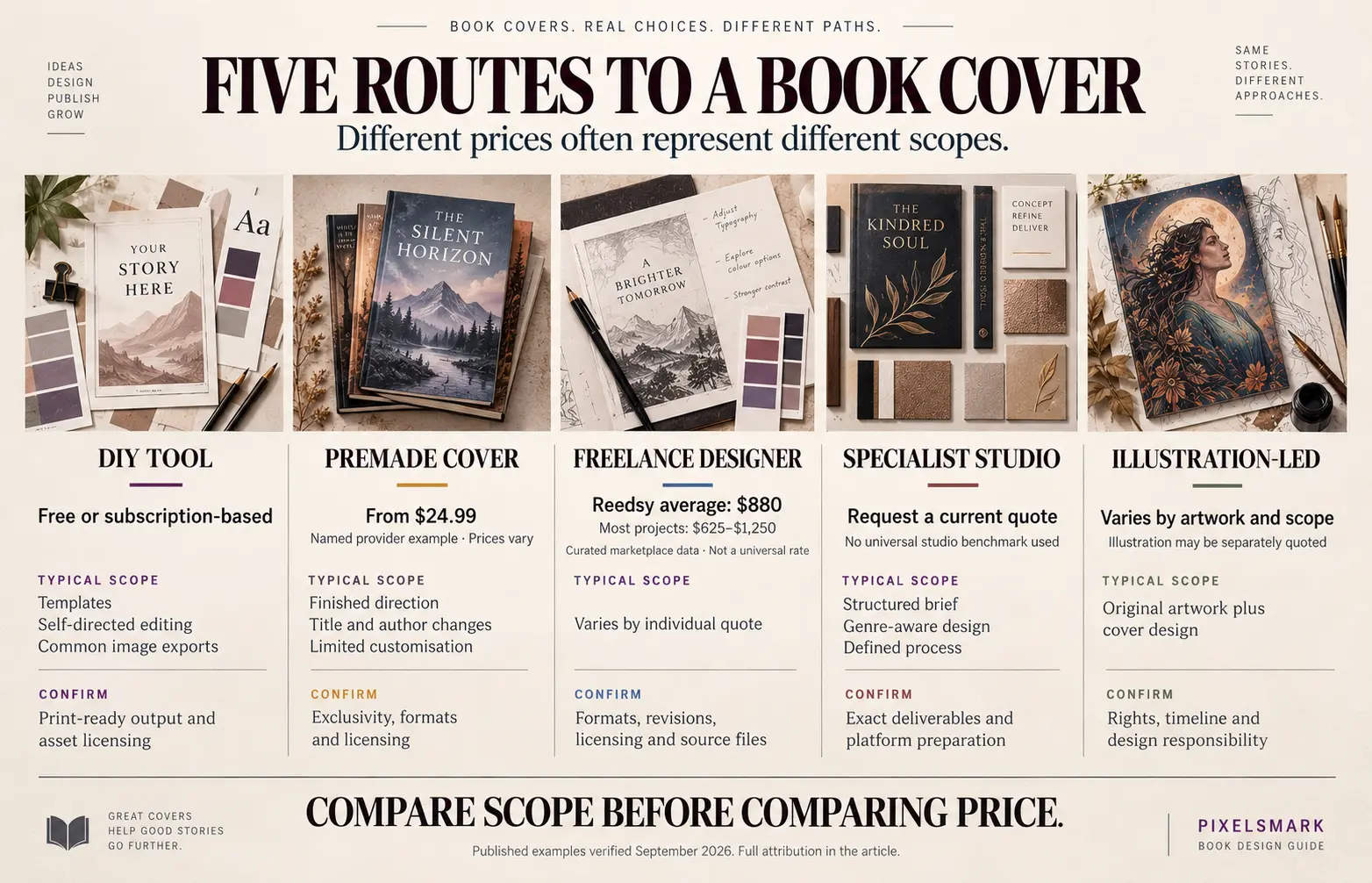
| Route | Price reference | What the scope typically covers | What to confirm before committing | Main consideration |
|---|---|---|---|---|
| DIY tool | Free or subscription-based (varies by tool) | Templates, font and image access, export to common formats | Whether the tool supports print-ready export at your platform's specifications; licensing of any included assets | Output quality depends on your own design judgment and genre knowledge; no designer input is included |
| Premade cover | DesignDusk, a specialist premade-cover provider, publishes covers from $24.99, with prices varying by design and package [DesignDusk pricing page]. This is a provider-published example, not a universal market average. | A finished cover design; title and name personalisation; format delivery varies by provider and package | Whether the cover is sold exclusively or shared; which formats are included (ebook front only, or print wrap as well); licensing terms for any stock imagery in the design | Customisation is limited; core imagery and layout are fixed; confirm format delivery matches your publishing requirements |
| Freelance designer (generalist or specialist) | No single industry-wide rate. Reedsy's marketplace data (9,600+ projects, 2025) reports an overall average of $880, with most projects between $625 and $1,250. Genre medians in its published data range from $470 for picture-book covers to $910 for fantasy covers. [Reedsy, 2026] Rates on general freelance platforms vary widely and may fall below or above these figures. Reedsy's figures reflect its own curated marketplace, not a universal freelance benchmark. | Varies significantly and may include one or multiple concepts, a defined number of revisions, front cover only or a full print wrap, and specific format deliverables. Scope must be confirmed per quote. | Genre experience; whether a print wrap is included; revision terms; stock-image licensing; source files; KDP technical delivery capability | Scope differences between quotes are the primary source of price variation at this tier; headline price alone does not indicate relative value |
| Specialist book-cover studio | Varies by studio and project scope. No universal studio benchmark is used here. Request a current quote and compare scope; Reedsy's figures are a separate curated-freelancer benchmark. Individual studios publish their own rates. | Cover design developed to a detailed brief; often includes multiple formats and a structured revision process. Exact deliverables depend on the studio and the agreed scope. | All items in the scope framework below; whether the studio has genre-publishing experience; platform delivery requirements | Price and scope vary significantly between studios; structured process and genre expertise are the primary differentiators from general freelancers |
| Illustration-led cover | Illustration cost varies widely and is often a separate engagement from cover layout and typography. No single benchmark is available. | Original artwork created for your book; cover design built around that artwork. Illustration and design may be provided by one person or two separate engagements. Confirm which applies. | Whether illustration and cover layout are separately quoted; who holds the rights to the original artwork; lead time for illustrated work | Illustration is resource-intensive and requires more lead time than stock-image-based design; it may also involve separate illustration and design contracts |
The figures above represent attributed published data from identified sources, not a composite market survey. Individual rates vary by experience, project scope and geography. Always request a current quote for your specific project. See the Sources and Methodology section for attribution details.
For authors considering a DIY approach before deciding on professional design, the Pixels Mark Book Cover Maker lets you explore genre directions and build a cover at no upfront cost.
Which Format Does Your Book Actually Need?
One of the most common sources of price confusion is the difference between an ebook cover and a print-ready cover. They are not the same deliverable, and not every quote includes both.
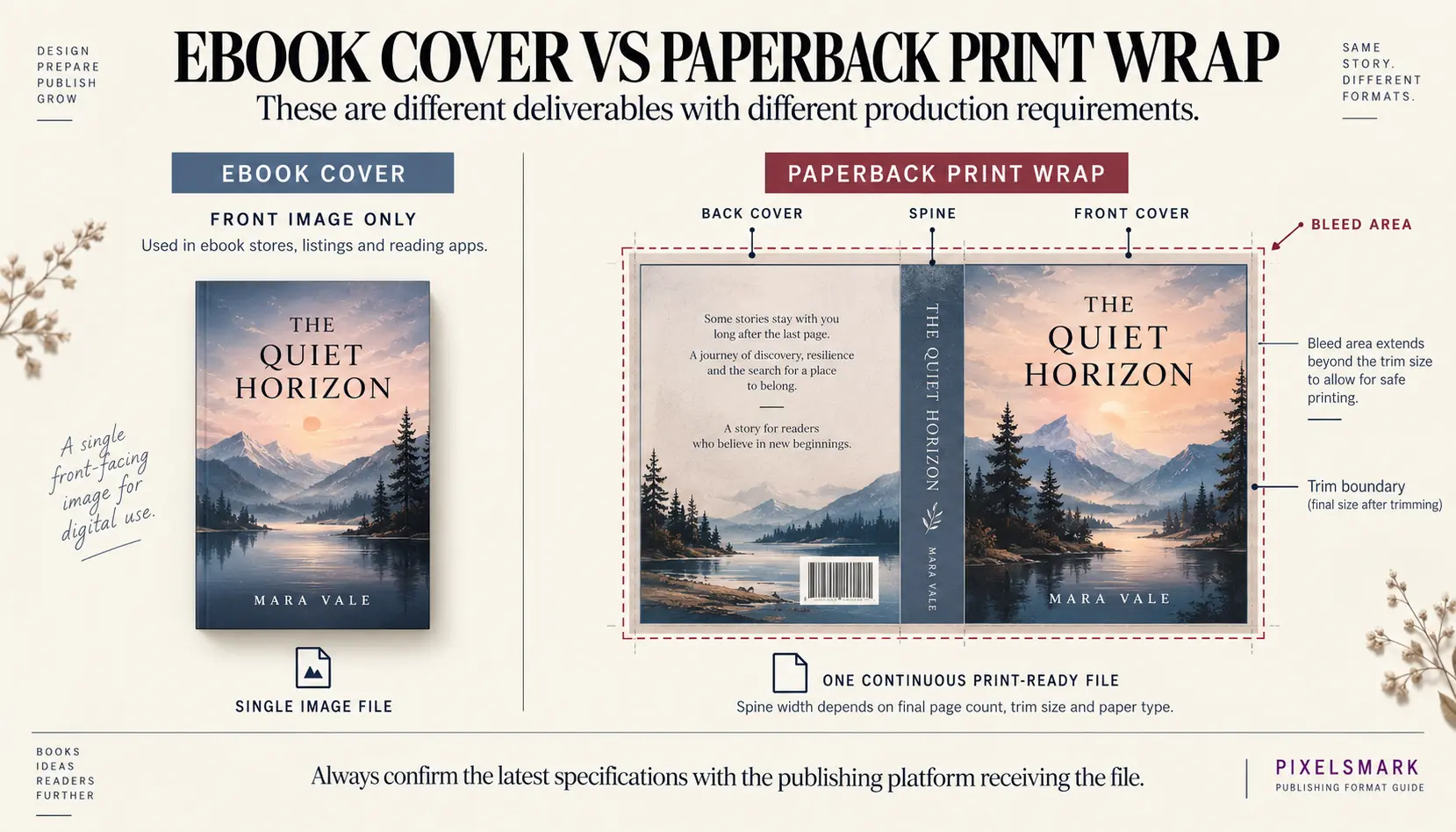
Ebook cover
A front-facing image file. This is what appears in online stores, on your Amazon detail page and in reading apps. It is the simplest deliverable and the one most often quoted as a stand-alone service. File-format requirements vary by platform; always verify the current specification for your chosen store before submission.
Paperback print wrap
A single continuous PDF file that includes the front cover, spine and back cover as one connected layout. Amazon KDP requires this format for paperback submission; other print platforms have their own specifications, which may differ and should be verified directly with each platform. The spine width is not fixed. It depends on your final page count, your chosen trim size and the paper type you use. This means a print wrap cannot be accurately prepared until your interior formatting is complete and the page count is confirmed. Designers who understand print publishing will ask for these details; those who do not may deliver a file that requires revision before it passes the platform's technical review.
Hardcover
Hardcover covers follow similar technical requirements to paperbacks but with different dimensions and specifications depending on the binding type. Not all designers who offer paperback design also offer hardcover. If hardcover is part of your plan, confirm this scope separately.
Audiobook square
Audiobook platforms require a square-format cover image. The visual treatment needs to work at that ratio, which is not always straightforward when adapting a portrait-format cover. Some designers include this as a standard deliverable; others quote it separately.
Series design
A series requires visual consistency across titles: matching typography, color palette, layout and any symbolic elements that appear across covers. Planning for series consistency from the start can reduce later redesign work and make it easier to maintain a coherent look across future titles. If you are writing a series, mention this at the briefing stage and ask how the designer intends to build and document that visual system.
The Book Cover Quote Scope Framework
This is the section most cost guides skip. Before you accept or reject a quote based on price alone, run it through these criteria. Two quotes can look comparable until you check which of these are included.
1. Ebook front or complete print wrap?
Is the quote for an ebook cover only, or does it include the full paperback layout (front, spine and back) in one print-ready PDF? If you plan to publish in print, confirm this before work begins.
2. Paperback and hardcover requirements
If print delivery is included, ask whether the designer will calculate the spine width for your specific page count and trim size, or whether you are expected to provide that information. Also confirm which paper type the design accounts for, since spine width varies between white, cream and colour paper.
3. Number of initial concepts
Some designers present two or three distinct initial directions for you to choose from. Others begin with one direction developed from the brief. Neither approach is inherently better, but knowing in advance sets realistic expectations for the first delivery.
4. Included revision rounds
Confirm how many structured feedback rounds are included before additional charges begin. A quote with one revision round and a quote with three are meaningfully different engagements. Also confirm what counts as a revision: adjusting typography and colours within an agreed direction is different from requesting a completely new creative direction.
5. Stock-image licensing
If the cover design uses stock photography, confirm whether the cost of licensing those images is included in the quote or billed separately. Also ask which licence tier applies, since standard licences may carry print-run limits that affect commercial publishing use. This is worth clarifying in writing before the design work begins.
6. Custom illustration
Illustration is almost always a separate cost from cover layout and typography. If your genre requires original artwork (fantasy world-building, hand-drawn characters, children's book illustration), you may be hiring an illustrator and a cover designer as two separate engagements, or one person who offers both. Confirm what the quote covers and what it does not.
7. Editable or source files
The layered source files (the InDesign, Photoshop or Illustrator documents used to build the cover), are not always included as standard. Without layered source files, future changes may require returning to the original designer or recreating parts of the artwork. Ask explicitly whether source files are included or available at an additional cost.
8. Audiobook square version
If you plan to produce an audiobook alongside your ebook and print edition, ask whether a square-format version of the cover is included or quoted separately.
9. Series branding and future-cover compatibility
If this is part of a planned series, ask how the designer intends to build visual consistency across future titles. This might mean delivering a style guide, using consistent typographic templates, or agreeing to handle subsequent covers at a defined rate.
10. KDP-ready print PDF
Ask whether the print file will be delivered to the exact technical specifications required by your publishing platform. This includes correct bleed, the right colour profile, embedded fonts and the correct PDF export settings. A file that passes a visual check but fails the platform's technical upload review will need further work before publication.
11. Spine adjustment if page count changes
If your manuscript is still being edited when the cover is commissioned, your page count, and therefore your spine width, may change between the initial design and submission. Ask in advance how the designer handles spine revisions in that situation and whether any adjustment is included or charged separately.
12. Commercial usage rights and ownership
Copyright transfer, commercial licensing terms and usage restrictions vary by contract and by provider. Do not assume that full ownership transfers automatically on payment. Confirm in writing what rights you receive, whether those rights are exclusive, and any limitations that apply. Stock images and fonts used in the design remain subject to their own original licences, which are separate from the designer's agreement with you. Ask the designer to identify which licensed assets are used and confirm whether those licences permit your intended publishing use.
13. Delivery timeline
A standard timeline and a rush timeline typically carry different prices. Confirm the expected delivery date for initial concepts and the overall project timeline when you agree terms.
14. Additional-format charges
If you later need the cover adapted for a hardcover edition, a foreign-language version, an updated spine for a reprinted edition or a new series entry, ask whether those are included or quoted as separate projects.
What Affects the Price Within Each Route
Once you have chosen a design route, several factors determine where within that route's range a specific project will land.
How the cover is produced. A cover built from stock photography and type sits at the accessible end of the cost scale. Photo manipulation, which combines multiple images into a cohesive scene, requires more skill and time. Fully original illustration, where an artist creates artwork specific to your book, is the most resource-intensive and typically the most expensive approach.
Designer experience and genre knowledge. A designer who has worked extensively in your genre brings more than technical skill. They understand what kinds of typography, imagery and composition work for your readership and what will position your book effectively on a genre shelf or in a category search result. This expertise is reflected in their rates.
Number of initial concepts. Presenting three distinct creative directions at the outset requires more time than developing one direction from a detailed brief. Both approaches are valid depending on how clear your vision is and how much creative exploration you need.
Revision depth and rounds. More structured revision rounds give you more opportunity to shape the direction but extend the project timeline and increase the designer's commitment. The clearer and more specific your brief, the fewer revision rounds most projects require in practice.
Genre complexity. Fantasy and science fiction covers with high visual complexity, period-accurate historical covers that require rare stock imagery, and illustrated children's covers all involve more creative problem-solving than typography-led nonfiction covers, where the challenge is concept and hierarchy rather than image sourcing.
Scope of formats and deliverables. A project that requires an ebook cover, a paperback print wrap, an audiobook square and a series style guide is more complex than one that requires only an ebook front cover. This should be reflected in the quote.
Timeline. Expedited delivery typically carries a premium. If your publication date is fixed and close, factor this in when requesting quotes.
Costs That Often Come Up After the Initial Quote
Some charges are not failures of transparency. They reflect scope that was not specified at the outset, or that changed during the project. Understanding what commonly falls outside a base quote helps you ask the right questions before committing.
Additional revisions. Most quotes include a defined number of feedback rounds. Requesting changes beyond that scope, or substantially changing the creative direction after work has begun, typically carries an additional charge.
Premium stock imagery. If a cover concept requires a specific image that is only available through a premium licence, this cost may be passed through separately. Confirm at the briefing stage whether the designer will source imagery within a defined budget or whether you will be invoiced for licensing separately.
Print-wrap adaptation. If a project was scoped as an ebook cover and you later need a print version, that is usually a separate engagement. If there is any possibility you will need a print edition, it is more efficient to scope both at the start.
Spine revision after page-count change. If your manuscript changes significantly after the cover has been prepared (due to editing, reformatting or a switch from cream to white paper), the spine width calculation changes. This usually requires a file revision, which some designers include and others charge for.
Source files. Layered source files are sometimes available for purchase separately if they are not included in the base quote. If you anticipate future changes to the cover, it is worth negotiating access to these at the outset rather than after the project closes.
Hardcover adaptation. Designing a hardcover version from an existing paperback cover is not usually the same as simply resizing. Cover dimensions, binding requirements and case specifications differ between formats and platforms.
Series extensions. Each additional book in a series typically requires a separate engagement, even if it follows a consistent design template. Some studios offer series rates; most quote each cover individually.
Rush delivery. Expedited timelines are almost always quoted at a higher rate. If you have a fixed launch date, disclose it when requesting the initial quote rather than requesting it as a last-minute addition.
Interior formatting. Cover design and interior formatting are separate services. Some studios offer both; many cover designers do not format interiors. If you need both, clarify at the outset whether each is included in the quote or whether you will need to source interior formatting separately.
Amazon KDP Technical Requirements
If you plan to publish through Amazon KDP, the cover files you submit must meet specific technical requirements. These requirements differ between ebook and print editions, and they are subject to change; always verify them at the time of submission.
Ebook cover. KDP requires a separate image file for your ebook cover. Current KDP guidance on ebook covers specifies accepted file formats and size requirements. Always check the current KDP ebook cover requirements immediately before submission, as specifications may be updated.
Paperback cover. For a paperback, KDP requires a single PDF file that includes the back cover, spine and front cover as one continuous image. The spine width is not a fixed measurement. It is calculated from your page count, your chosen trim size and your paper type. KDP provides a cover size calculator and template generator for this purpose. Using the calculator with your confirmed final page count before delivering the brief to a designer, or before finalising a print file, will avoid revisions caused by an incorrect spine width.
KDP also specifies bleed requirements, minimum image resolution for print, colour-profile recommendations and file-size limits. A designer experienced with KDP paperback submission will know these requirements and account for them in the file they deliver. If you are unsure whether a designer has this experience, ask whether they have produced KDP-ready print files before and whether the delivery will meet KDP's current upload requirements.
Technical specifications for KDP publishing are confirmed by Amazon and may change. Verify all requirements at kdp.amazon.com before your final submission.
Choosing the Route That Fits Your Situation
No route is universally right. The decision depends on your budget, your timeline, your publishing objectives and how much creative direction you need.
DIY tools work when
You have a clear sense of what your cover should look like and you are comfortable making design decisions yourself. DIY tools are also practical for testing a cover direction before investing in professional design, for social media graphics and for placeholder covers while a manuscript is still being developed. The risk is that a technically competent result without genre knowledge may not position your book effectively on a retail shelf.
Premade covers work when
You find a ready-made design that genuinely fits your book's genre and tone, and the customisation available (typically title and author name) is sufficient for your needs. Premade covers from specialist providers who sell each design once give you a polished result at a lower price than custom design, without the risk of seeing the same cover on another book. Some premade packages include a paperback print wrap; others cover only the ebook front. Confirm which formats are included and whether the technical delivery meets your platform's requirements before purchasing.
A freelance designer works when
You need individual attention and a custom result but have a moderate budget and a clearly defined brief. The most important factor when working with a freelance designer is their familiarity with your genre and with publishing technical requirements. Portfolio and genre experience matter more than the platform through which you find them.
A specialist studio works when
You are publishing commercially, your book needs to compete on a genre shelf, you require both ebook and print delivery, or you are building a series. Specialist studios focused on book cover work bring genre experience and publishing-platform knowledge that generalist designers may not have. They also typically offer a more structured process, which can reduce the friction that comes from miscommunication at the briefing stage.
Custom illustration works when
Your genre requires original artwork that cannot be approximated with stock photography: fantasy world-building, illustrated children's books, literary fiction with a distinctive visual concept. Be prepared to work with an illustrator and a cover designer as potentially separate engagements, and to plan significantly more lead time than a stock-image-based cover requires.
For illustrated children's books, compare the composition, character placement and title treatment in our children's book cover design examples before preparing your brief.
Pixels Mark Book Cover Options
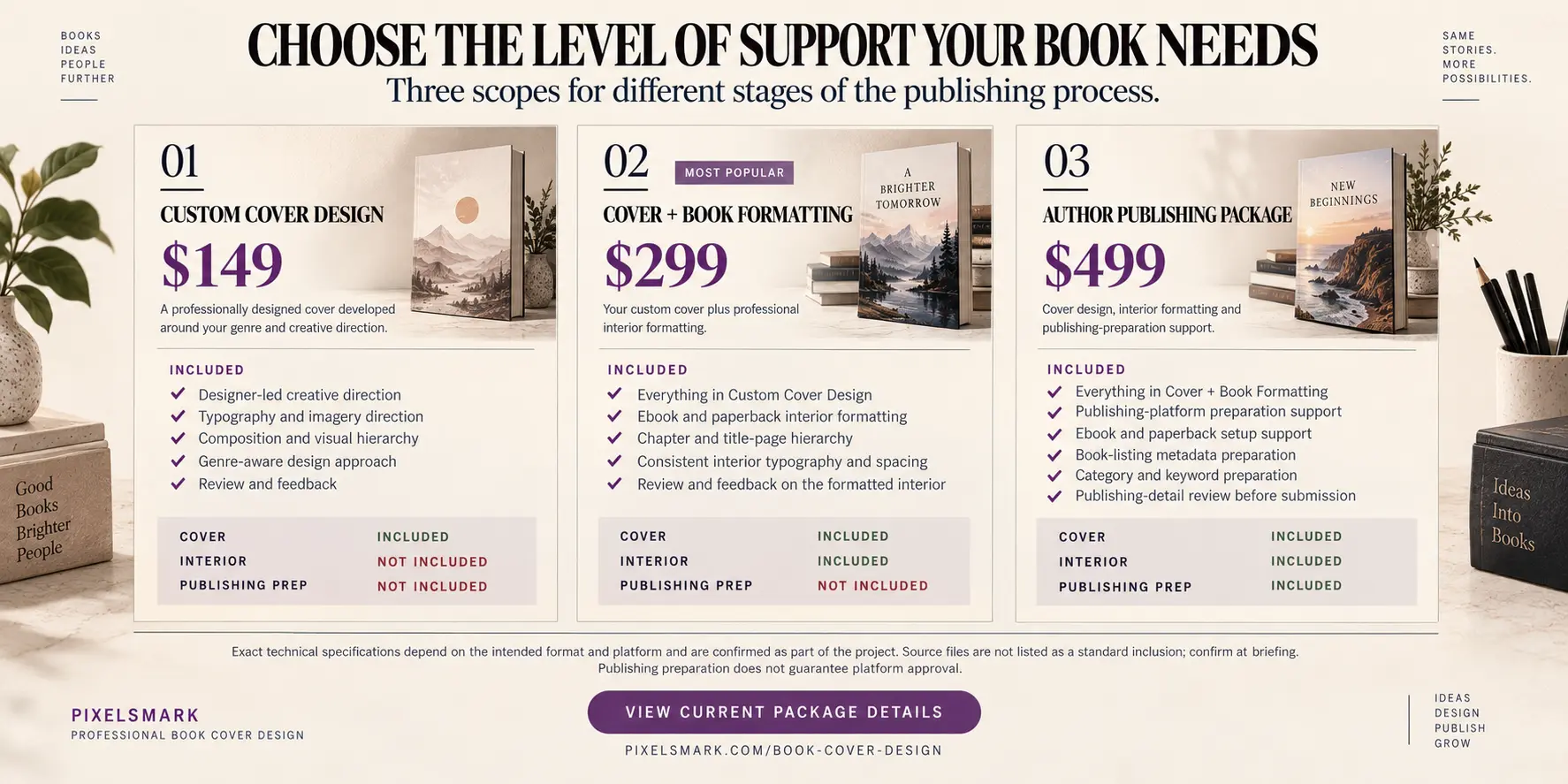
Pixels Mark offers two routes for authors working on a book cover: a DIY maker and a professional design service.
Book Cover Maker
The Pixels Mark Book Cover Maker lets you design your own cover using genre-specific templates and customisation tools. It is suited to authors who want to explore directions themselves or who need a cover quickly without designer involvement.
Professional Book Cover Design service
Pixels Mark's professional design service is structured around three packages, each covering a different scope. The following details are confirmed from the live service page at the time of writing. Verify current package details at pixelsmark.com/book-cover-design before purchasing.
| Package | Price | Includes | Does not include (standard) |
|---|---|---|---|
| Custom Cover Design | $149 | Designer-led creative direction; typography and imagery direction; composition and visual hierarchy; genre-aware approach; review and feedback on the cover direction. Exact file specifications confirmed as part of the project. | Interior formatting; publishing preparation; source files not listed as standard inclusion (confirm at briefing) |
| Cover + Book Formatting | $299 | Everything in Custom Cover Design; ebook and paperback interior formatting; chapter and title-page layout; consistent interior typography and spacing; review and feedback on the formatted interior | Publishing preparation; source files not listed as standard inclusion (confirm at briefing) |
| Author Publishing Package | $499 | Everything in Cover + Book Formatting; ebook publishing setup support; paperback publishing setup support; book-listing metadata preparation; category and keyword preparation; review of publishing details before submission | Platform approval is not guaranteed; source files not listed as standard inclusion (confirm at briefing) |
Additional services (editing, book marketing, author website, audiobook production, children's book illustration) are available from Pixels Mark by custom quote.
Pixels Mark's $149 package represents a specific scope at a defined price. For context, Reedsy's analysis of its marketplace, covering projects completed in 2025, found an average professional cover cost of $880, with most projects between $625 and $1,250. That data reflects engagements through Reedsy's curated freelancer platform, which represents a different scope from an entry-level package. Comparing the two headline figures directly would be misleading. The appropriate comparison is to evaluate what each specific quote includes and decide which scope fits the project.
Designer-led cover direction from $149
Book Cover Quote Comparison Checklist
Before paying any designer, ask these questions and confirm the answers in writing:
Scope and formats
- Does the quote include the ebook front cover, the paperback print wrap, or both?
- If print is included, will the designer calculate the spine width from the final confirmed page count?
- Is hardcover included or separate?
- Is an audiobook square version included or separate?
Creative process
- How many initial concepts will be presented?
- How many structured revision rounds are included before additional charges apply?
- What constitutes a revision: refinement within an agreed direction, or requesting a new direction?
Imagery and licensing
- Is stock-image licensing included in the quote, or will it be billed separately?
- Does the licence cover commercial publishing use without print-run restrictions?
- If illustration is involved, is it included in the quote or a separate engagement?
Files and ownership
- Will you receive source or editable files, or only flattened exports?
- What usage rights does the contract grant you, and are there any restrictions on commercial use, print-run volume or resale?
- What licences apply to any stock images or fonts used in the design, and do those licences cover your intended publishing use?
- What file formats will you receive?
Technical and platform delivery
- Will the print file be delivered to KDP specifications (or the specifications of your chosen platform)?
- If the page count changes before final delivery, is a spine adjustment included?
- What colour profile will the print file use?
Timeline and extras
- What is the expected delivery date for initial concepts?
- Is there a rush-delivery option, and what does it cost?
- Are series extensions quoted at a defined rate?
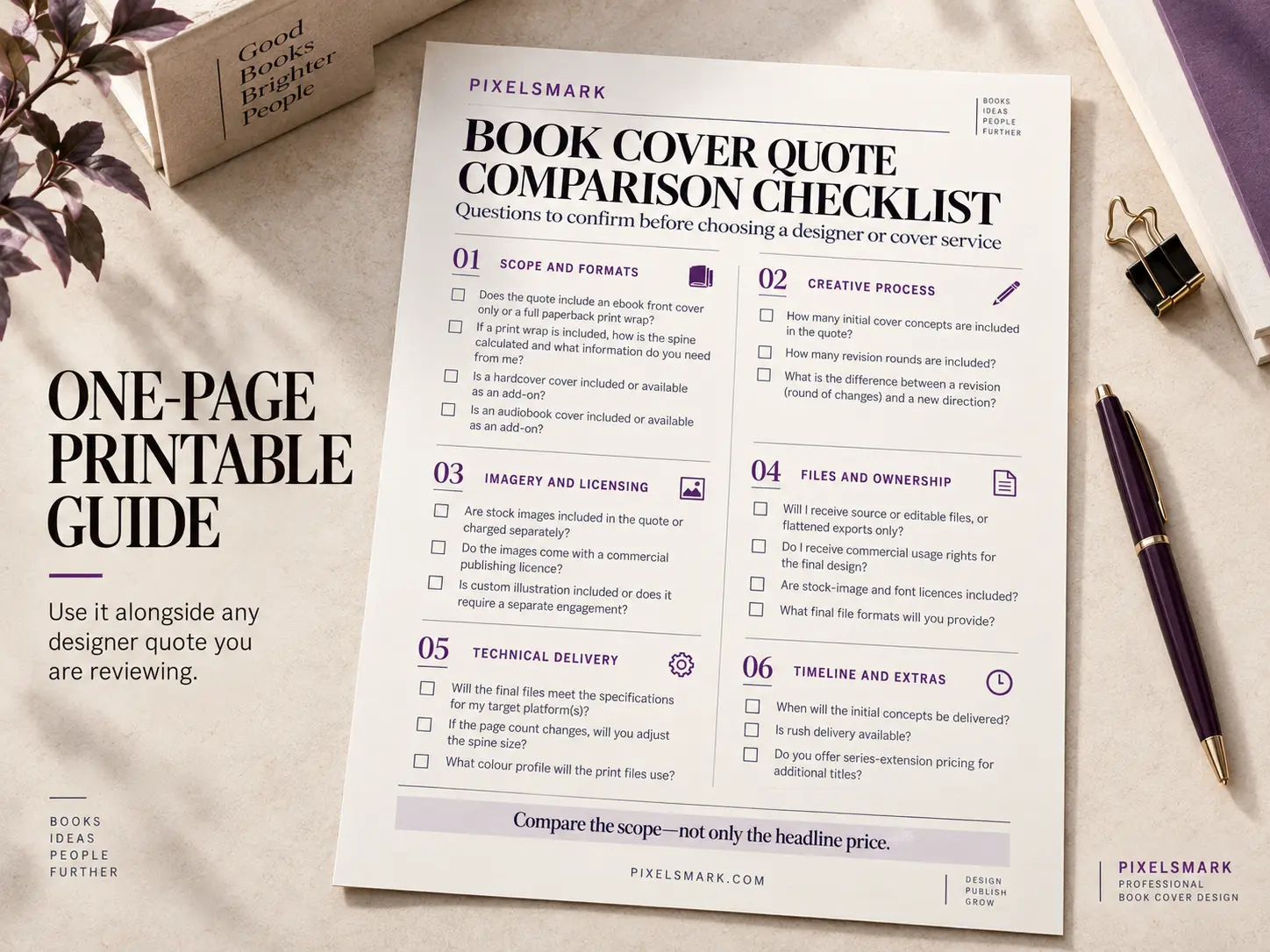
The questions above are also available as a one-page printable PDF. Download it to use alongside any designer quote you are reviewing.
Download the Book Cover Quote Comparison Checklist One-page PDF · Free downloadHow to Make the Final Decision
Book cover design cost is a function of what you actually need the cover to do. An ebook front cover for a first self-published title has different requirements from a full print wrap for a commercial genre release or the first book in a planned series. Getting clear on format, scope and commercial objective before reviewing any quote will make every comparison more useful.
For authors testing the market or working with limited budgets, a DIY tool or a premade cover from a specialist provider can be a practical starting point, particularly if the design fits the genre and the format delivery matches the publishing platform. For authors publishing commercially or needing a print-ready file, a designer or studio with genre experience and demonstrated KDP delivery capability is likely a better fit, and the quote should reflect the full scope: formats, revision rounds, licensing, source-file access and delivery timeline.
No route is right for every project. The most useful question is not which option costs the least but which quote delivers the specific work your book requires. Before requesting a quote, prepare a book cover design brief so the designer can understand your reader, formats and any production details still to confirm.
If you are ready to explore cover directions yourself, the Pixels Mark Book Cover Maker lets you start without upfront cost. If you want a designer to develop the cover around your book's brief, Pixels Mark's Book Cover Design packages start at $149.
No upfront cost · Explore a direction yourself
Frequently Asked Questions
How much should an indie author budget for a book cover?
Start by deciding which formats you need: ebook only, or ebook and print. Then compare quotes within that scope. Premade covers from specialist providers start from around $25 (DesignDusk publishes prices from $24.99, varying by design). For professional custom design, Reedsy (a transparent marketplace benchmark used in this article) reported an average of $880 and a common range of $625–$1,250 across its 2025 projects, with genre medians ranging from $470 for picture-book covers to $910 for fantasy covers. These figures reflect Reedsy's own curated platform. Rates outside that marketplace vary widely. The right budget is the one that matches the scope your book genuinely needs. Use the framework in this article to compare what each quote actually delivers before deciding.
Does an ebook cover cost less than a paperback cover?
Usually, yes. An ebook cover is a single image: the front face only. A paperback requires a full print wrap: front, spine and back in one continuous print-ready file. The spine width alone requires calculation from your confirmed page count. Designing and delivering a print wrap involves more technical work than an ebook cover, and it is reflected in most professional quotes. If you need both, scope them together from the start rather than adding print as an afterthought.
What is normally included in a book cover design quote?
There is no universal standard. A quote might include one or more initial concepts, a defined number of revision rounds, stock-image licensing, a specific format or set of formats, and source files; or it might include only some of these. The scope framework in this article is designed to help you check each of these criteria against any quote you receive, so you can compare what is actually included rather than comparing headline prices.
Is a premade cover as good as a custom-designed cover?
A premade cover from a specialist provider who understands genre conventions can be effective, particularly if the design genuinely fits your book. The limitation is customisation: you can typically change the title and author name, but not the core imagery or layout. A custom cover can be built entirely around your specific brief. Whether the difference matters depends on how specific your requirements are and how competitive your genre is. Both are legitimate options; neither is automatically superior.
Do book cover designers include source files?
Not automatically. Source files, meaning the layered documents used to build the cover, are sometimes included as standard and sometimes available at an additional cost. Without layered source files, future changes may require returning to the original designer or recreating parts of the artwork. If you anticipate needing to update the cover in future (for a new edition, a series continuation or a spine adjustment), ask about source files before agreeing terms.
What should I ask before paying a designer?
The checklist above covers the most important questions: scope (which formats are included), creative process (how many concepts and revisions), imagery licensing, source files, commercial rights, KDP technical delivery, timeline and how post-project changes are handled. Ask these before work begins and confirm the answers in writing. The answers will tell you more than the headline price.
Sources and Methodology
Pricing references in this article were verified in September 2026. They represent published data from identified sources at that date and are intended as general orientation, not guaranteed market rates. Provider pricing changes; always request a current quote for your specific project.
Reedsy marketplace data. The average cost of $880 and the range of $625–$1,250 cited in this article are drawn from Reedsy's published analysis of cover-design collaborations from 2025. This data reflects projects completed through Reedsy's curated freelancer marketplace and should not be read as a universal industry benchmark. Reedsy is used in this article as a transparent marketplace benchmark with published methodology.
DesignDusk premade pricing. Premade cover prices starting from $24.99 are published on DesignDusk's book cover design cost page at the time of writing. Prices vary by design and package. DesignDusk's pricing is used as a named provider-published example, not as a general premade-cover market average.
Pixels Mark package pricing. Package prices and inclusions are taken from the live Pixels Mark Book Cover Design service page, verified September 2026. These are Pixels Mark's own published prices, not third-party data.
Amazon KDP requirements. Technical specifications are sourced from official Amazon KDP documentation: KDP ebook cover requirements, KDP paperback cover requirements, and the KDP cover calculator. Specifications may change; verify at the time of submission.
No single third-party source was treated as a universal market benchmark. Freelance and studio price ranges cited in this article reflect the sources attributed above; they do not represent a composite market survey or independently derived average.