
Author
Pixels Mark
Release
Intensity
17 MIN READ
Neither route is universally better. A photography logo maker tends to suit photographers who have a clear sense of their visual direction, want direct control over the process and need a logo for straightforward applications such as a website header, social profile and watermark. Custom logo design tends to make more sense when differentiation matters strategically, when the concept requires deeper creative development, or when the logo needs to anchor a wider brand system. A hybrid approach, starting with a logo maker and involving a designer later, is a legitimate path. Choose the route that fits the complexity of the problem, not the one that sounds more professional.
Photography Logo Maker vs Custom Logo Design at a Glance
These differences reflect general patterns. Your experience will depend on the specific platform, designer, project scope and what is agreed before work begins.
| Factor | Logo Maker | Custom Logo Design |
|---|---|---|
| Creative direction | Photographer-led | Collaborative |
| Starting speed | Usually faster | Usually a longer process |
| Customization | Tool-dependent | Tailored to agreed project scope |
| Originality | Depends on assets and how much you customize | Developed around an individual brief |
| Strategy input | Usually self-directed | Can include strategic input |
| Revisions | You control edits directly | Depends on designer and agreed process |
| File delivery | Depends on the platform | Depends on agreed deliverables |
| Brand system | Often logo-focused | Can expand into a wider identity |
| Best fit | Straightforward or self-directed needs | More complex or broader identity needs |
When Is a Photography Logo Maker Enough?
A logo maker makes sense when the business problem it is solving is genuinely straightforward. That is not a criticism — most photography businesses at some point in their development have a straightforward logo need.
If you know roughly what visual direction fits your work, want to experiment with options yourself, and primarily need a logo for digital applications such as a website header, social profile, gallery watermark and business card, a photography-specific logo maker can produce a usable, professional result. You control the typeface, the color, the mark and the spacing. You can test multiple directions in a short period. You do not need to wait for a design process to conclude.
This route tends to work well when:
- You are building or refreshing a personal brand as a solo photographer
- The identity requirements are clear and contained — a logo and common digital assets
- You want direct control over edits without coordinating with another person
- You are exploring directions before committing to a final approach
Illustrative scenario: An Austin-based wedding photographer starting their second year in business knows they want a refined serif wordmark with their name and a subtle descriptor. They have a clear visual preference, and the identity does not need to extend beyond their website, Instagram profile, gallery watermarks and printed business cards. A photography logo maker gives them direct control over that decision, and they can test several type combinations before downloading the final files.
SVG & PNG Download · No Account Required
When Does Custom Logo Design Make More Sense?
The case for custom logo design is not about prestige or budget. It is about the type of problem being solved.
Custom design becomes the more appropriate route when the brief goes beyond producing a mark. If you need a designer to interpret something genuinely specific about the business — a particular positioning, a visual concept that does not exist in a library, a multi-part identity system that needs to feel consistent across very different applications — a collaborative process offers something a self-directed tool does not: creative direction.
This route tends to fit better when:
- The current identity no longer represents the business, and you are not sure what should replace it
- Differentiation is strategically important in a competitive local market, and you want a mark that cannot be confused with a competitor's
- The logo concept requires a level of exploration and interpretation that goes beyond adjusting existing assets
- The identity needs to extend into a wider system — signage, client documentation, packaging, printed materials
- You want input on the strategic positioning behind the visual, not just the visual itself
Illustrative scenario: A London commercial photography studio working with advertising agencies and corporate clients has grown from a solo practice into a team of three photographers and a producer. The current logo was built quickly several years ago and no longer reflects the studio's output or client expectations. The studio needs a mark that works across pitch decks, studio signage, vehicle wraps and agency-facing email templates. The scope of that problem goes beyond what a self-directed tool is designed to solve. A designer who can work with a full brief — and deliver a set of assets built around that specific system — makes more sense here.
A Logo and a Brand Identity Are Not the Same Thing
This distinction prevents a common and expensive mistake.
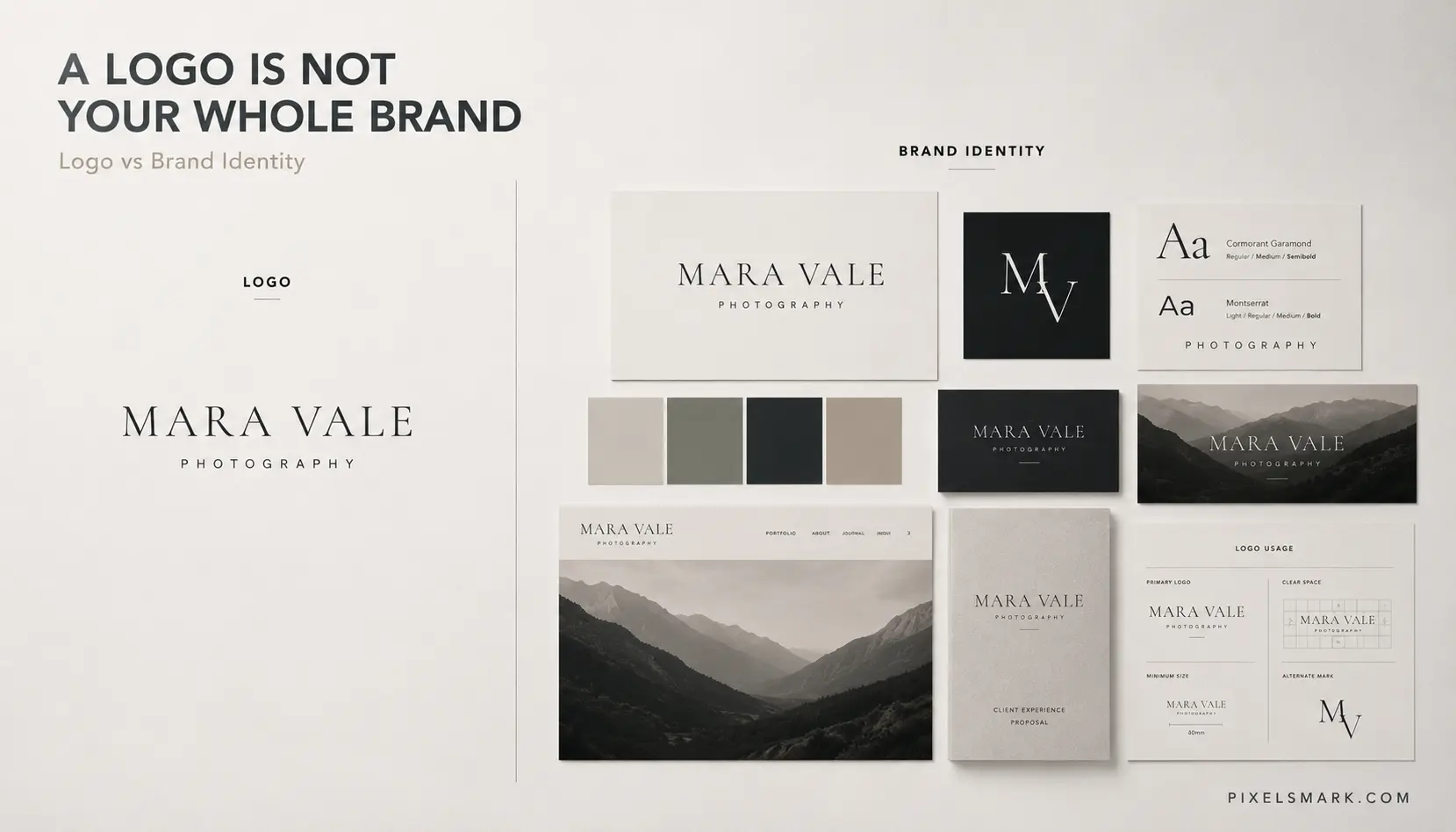
A logo is an identifying mark. A brand identity is a system: it may include primary and secondary marks, a defined typographic hierarchy, a color system, layout principles, image treatment guidelines, supporting graphic elements and usage documentation.
If the only problem is that you need a recognizable mark, you do not automatically need a full identity rebrand. Building one when you only needed the other is a longer, more expensive process than the situation requires.
If the entire visual system is inconsistent — the website, the galleries, the proposals, the social profiles and the printed materials all look slightly different from each other — then changing only the logo will not fix that. The underlying problem is the absence of a system, not just the absence of a good mark.
Before deciding between a logo maker and a designer, decide what the actual scope of the problem is. That decision shapes everything else.
Creative Control: Who Should Drive the Process?
The question of creative control is worth thinking through honestly, because it affects which route will actually produce something you can use.
With a logo maker, you are the designer. You choose the typeface, adjust the spacing, select the color, add or remove elements and decide when the result is finished. That is a genuine advantage if you have a clear visual sense of your brand direction. It is a genuine disadvantage if you are uncertain what the right direction is, because the tool cannot advise you — it can only produce what you configure.
With a custom designer, the process is collaborative. You bring the brief, the context, the examples and the preferences. The designer brings interpretation, creative development and professional judgment. This does not mean you lose control — it means creative control is shared, which tends to produce something more developed than either party could produce alone. What you give up is the ability to make every individual change yourself in real time.
Neither arrangement is inherently better. The right one depends on whether you need a tool for execution or a collaborator for exploration.
Originality and Distinctiveness
Both routes can produce a logo that is genuinely distinctive. Both routes can produce a logo that looks like many others. The output depends on execution, not on the type of process.
A logo maker's originality comes from how you customize within the available options — the typeface combination, the specific color choice, the spacing and proportional decisions. A heavily customized result from a good tool, in the hands of someone with clear visual direction, can stand apart in a local photography market. A template used with default settings, minimal customization and common color choices will not.
Custom design's originality comes from the depth of the brief and the quality of the creative development. A thorough brief that describes the studio's actual positioning, clients, visual references and competitive context gives a designer more to work with. A vague brief produces less distinctive results regardless of the designer's capability.
Neither route automatically provides trademark clearance or legal exclusivity. If protecting the mark matters for your business, trademark registration is a separate process that requires independent professional review regardless of how the logo was created.
What Files Should a Photographer Receive?
Before committing to either route, ask specifically what files you will receive and in what formats. This is a practical question that affects how the logo can actually be used.
SVG (vector): Scales without quality loss and works well for responsive web use, print workflows that accept SVG, and applications where the logo needs to appear at different sizes.
Transparent PNG: The working format for watermarks, digital overlays, gallery thumbnails and social profile images. The transparency means the logo sits cleanly on any background.
JPEG: Useful when a flattened image with no transparency is specifically required. It is usually a secondary logo format rather than the main file used for overlays or scalable applications.
Depending on the scope agreed with a designer, you may also receive source files, additional format variations, a one-color version, a reversed version or usage guidelines.
For a detailed explanation of when each format is appropriate across photography applications, the PNG vs SVG vs JPG format guide covers the practical decisions in full.
Where the Logo Will Actually Appear
A photography business uses its logo across more contexts than most other small businesses. Before choosing a route, map where the mark will actually appear, because some of those contexts have specific requirements.
Digital applications: Website header, social media profile images, client gallery thumbnails, portfolio pages, email signature.
Client-facing documents: Proposals, pricing guides, invoices, contracts, welcome packs, delivery emails.
Watermarks: Portfolio images shared on social media, client previews, online galleries. The logo needs to remain legible at reduced opacity and small sizes.
Print: Business cards, studio stationery, thank-you cards, packaging for delivered work, printed promotional materials.
Larger format: Studio signage, event backdrops, vehicle wraps where relevant.
Not every photography business uses all of these. A solo portrait photographer may only need digital formats and a business card. A studio with a physical location, a team and a wide client base may need a mark that works consistently across all of them.
The wider the range of applications, the more important it is that the logo comes with the right formats, and the more likely it is that the identity as a whole needs some level of systematization. For guidance on the print side, our photography business card ideas guide covers how a logo translates into physical brand applications.
Brand Consistency: Self-Managed or Systematized?
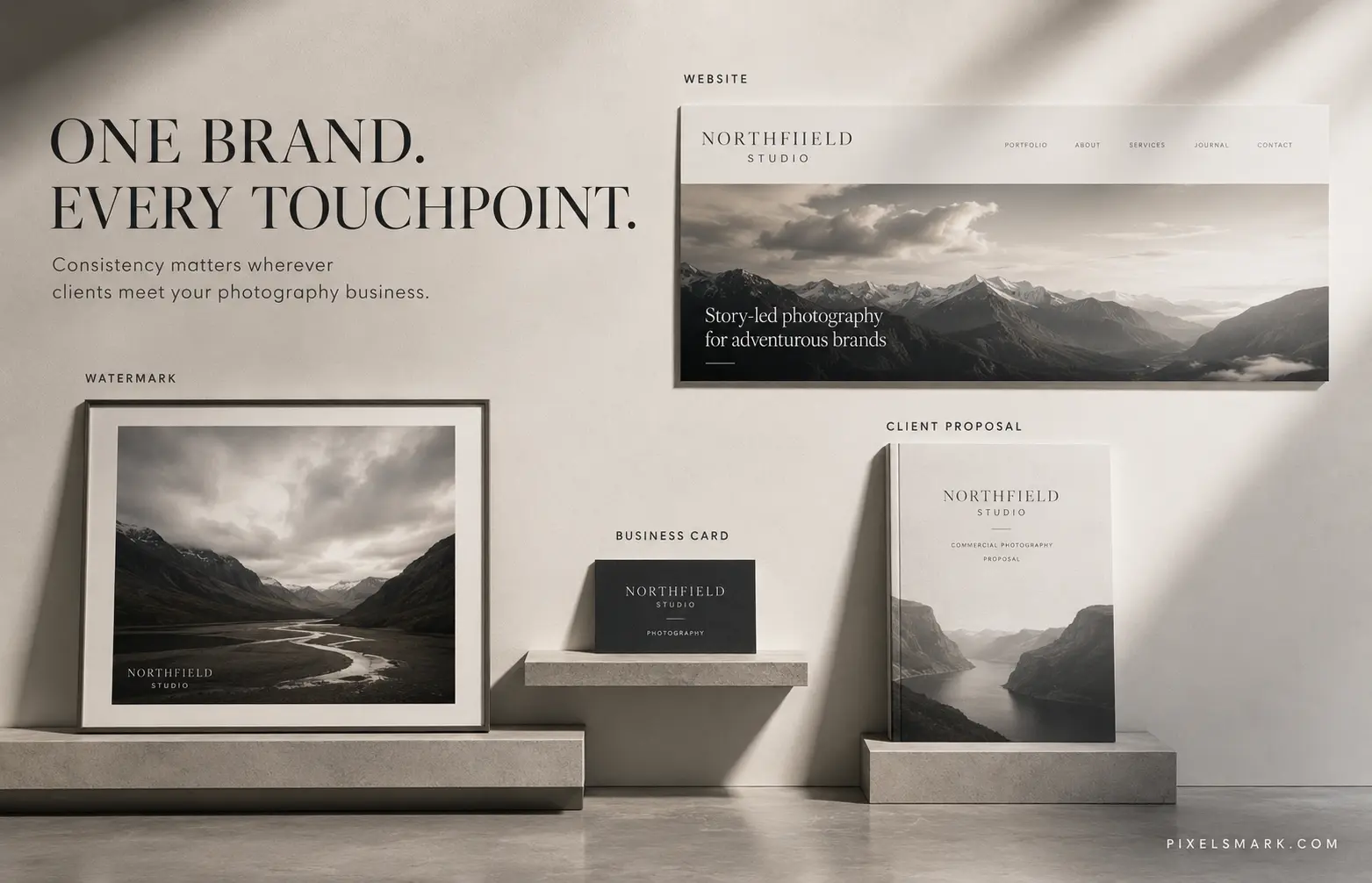
A consistent brand identity, where the website, the galleries, the proposals, the social profiles and the printed materials all feel like they belong to the same business, is achievable through either route. The question is how much of that consistency you want to manage yourself.
With a logo maker, consistency is self-managed. You apply the mark across platforms yourself, maintain the color values yourself and adapt the logo to different applications yourself. That works well when the applications are contained and the photographer has the time and inclination to manage it.
With a designer who delivers a wider identity system, some of that consistency is built into the deliverables: defined color values, typeface specifications, usage notes, multiple mark variations for different contexts. The system does some of the work for you.
Both approaches can produce a consistent result. The difference is the amount of self-direction involved in maintaining it.
Three Photography Business Scenarios
These scenarios are illustrative. They are not client case studies or verified outcomes.
Austin wedding photographer — logo maker likely fits. A second-year wedding photographer in Austin has built their initial client base through word of mouth and Instagram. They have a clear visual direction — warm and editorial — and need a refined wordmark for their website, social profile and gallery watermarks. The identity requirements are contained, and they want to control the result themselves. A photography logo maker suited to their visual direction is a practical starting point.
Sydney portrait photographer — either route or a hybrid. A Sydney portrait studio has been operating for four years and is considering a refresh. The current logo works but feels generic. They are not sure whether the issue is the mark itself or the way it is being applied across different platforms. Before committing to custom design, they could use a logo maker to test several directions. If the result feels right, they are done. If the identity needs more development — a cleaner system, guidance on type and color — bringing in a designer at that point is a natural next step.
London commercial photography studio — custom design likely fits. A London studio working with advertising agencies and brand clients has grown significantly since the founding identity was built. The mark needs to work across pitch decks, studio signage, team email signatures and agency-facing materials. The scope of the problem goes beyond a logo and into a system. Custom design that delivers a wider set of assets and usage guidelines is the more appropriate route.
Can You Start With a Logo Maker and Move to Custom Design Later?
Yes — and this is a reasonable path for many photography businesses, not a compromise.
Starting with a logo maker lets you explore visual directions directly and test different approaches before deciding whether broader design support is necessary. If the result meets your needs, the process is complete. If the business grows and the identity requirements expand — more applications, a wider team, a more competitive market — bringing a designer into a more developed brief at that stage is entirely practical.
The one thing worth avoiding is treating the first logo as a placeholder you will definitely replace. If you commit to a mark — apply it consistently across your platforms and client materials — it does the job it is designed to do while you build the business. Upgrading later is an option, not an obligation.
Decision Checklist
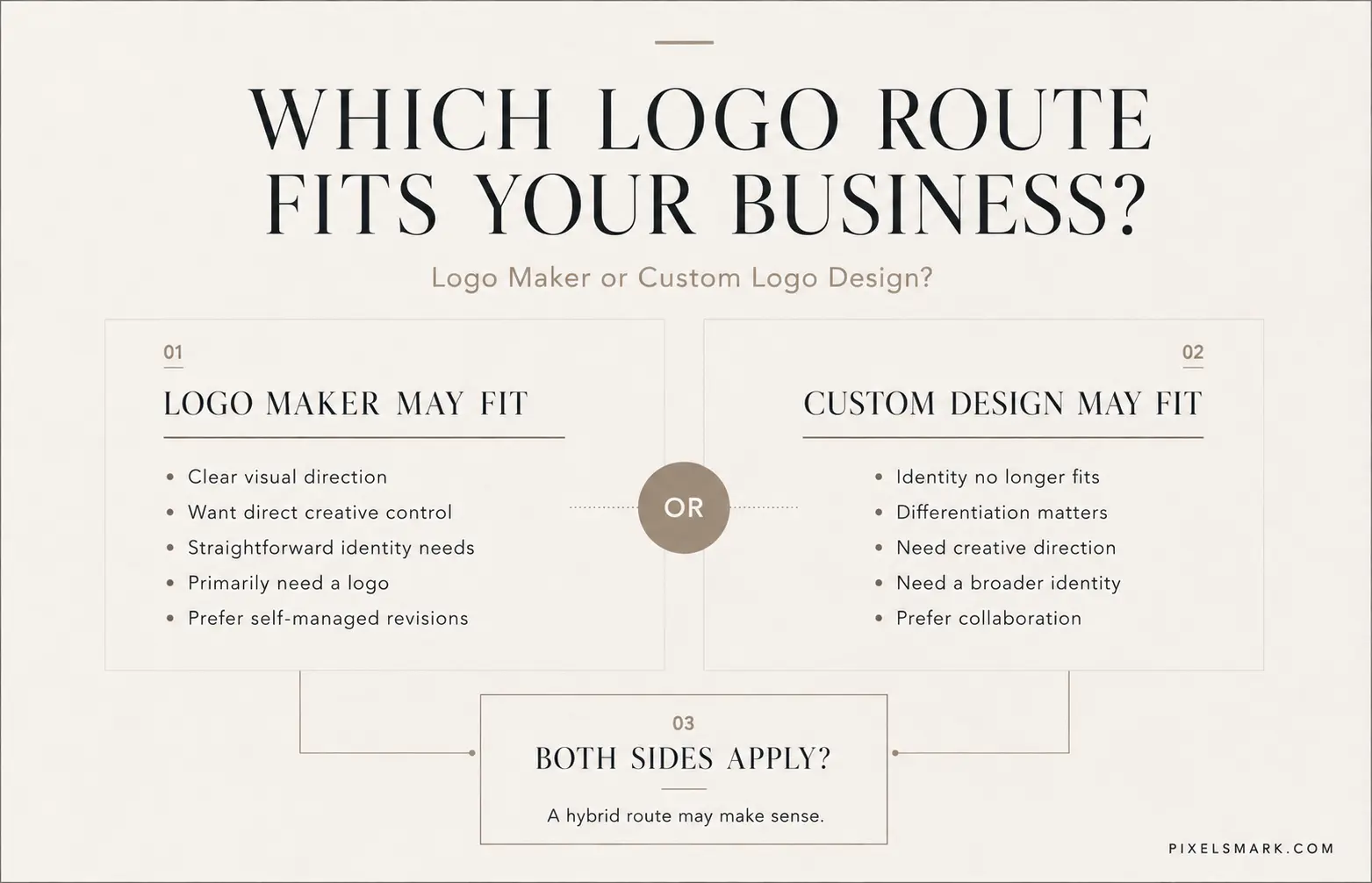
A photography logo maker may fit if:
- You have a clear sense of your visual direction
- You want to experiment and control the result yourself
- Your identity requirements are straightforward and contained
- You primarily need a logo and common digital formats
- You want direct control over revisions without coordinating with another person
Custom logo design may fit if:
- Your current identity no longer represents the business
- Differentiation is strategically important and the brief is genuinely specific
- The concept requires development beyond selecting and adjusting existing assets
- The logo needs to anchor a broader identity system across multiple applications
- You want creative direction and collaborative input, not just execution
If items on both lists apply, a hybrid route — starting with a logo maker to explore directions, then working with a designer on a more developed system — is worth considering.
Photography Logo Maker vs Custom Logo Design: Final Decision
There is no universal answer, and there should not be. The right route depends on the complexity of the problem being solved.
If the problem is creating a recognizable, professional mark for a focused set of applications and you have a clear visual direction, a photography logo maker is a practical and legitimate solution. If the problem is deeper — an identity that no longer fits the business, a concept that requires creative exploration, a system that needs to work across a wide range of client-facing contexts — custom design addresses something a self-directed tool is not built to solve.
"Choose your branding route based on the complexity of the problem — not the prestige of the process." — PixelsMark
The same principle applies to file formats, revisions and brand consistency: the right solution is the one that genuinely fits the scope of what you need, not the one that sounds more sophisticated.
Self-directed route
Generate, customize and download a photography logo with direct control over every detail.
Create Your Photography LogoProfessional design route
Work with a designer on a brief built around your specific photography business and identity needs.
Explore Professional Logo DesignAI Summary
- A photography logo maker and custom logo design are two different tools for two different types of problems. Neither is universally superior.
- A logo maker suits photographers who have a clear visual direction, want direct control and need a logo for contained applications.
- Custom logo design suits photographers whose brief requires deeper creative exploration, collaborative development or a broader identity system.
- A hybrid route — using a logo maker to explore directions, then working with a designer as the business grows — is a practical approach, not a compromise.
- The key distinction is between a logo (an identifying mark) and a brand identity (a system of visual assets and usage guidance). Knowing which one you actually need prevents unnecessary expense.
- File delivery matters: ask specifically what formats you will receive before committing to either route.
- Brand consistency is achievable through both routes. The difference is how much self-direction is involved in maintaining it.
- Choose the route that fits the complexity of the problem, not the one that sounds more prestigious.
Frequently Asked Questions
Is a photography logo maker good enough for a professional photographer?
It depends on the scope of the need. A photography logo maker can produce a professional, usable mark that works across websites, social profiles, watermarks and printed materials. A logo maker can remain sufficient for a professional photographer when the identity requirements stay relatively straightforward. Other businesses may eventually need broader creative or brand-system support as their requirements become more complex. Whether it is enough depends on how specific the brief is, how much creative development the concept requires, and what applications the logo needs to cover.
When should a photographer hire a logo designer?
When the brief goes beyond producing a mark. If your current identity no longer represents the business, if differentiation matters strategically in a competitive market, if the concept requires creative development rather than execution, or if the logo needs to anchor a wider brand system across multiple applications, a designer who works from a full brief is more appropriate than a self-directed tool.
Is custom logo design more original than using a logo maker?
Not automatically. Originality depends on execution, not on the type of process. A logo maker used with clear direction and deliberate customization can produce a distinctive result. A designer working from a vague brief can produce something generic. The depth of the brief and the quality of the development determine how distinctive the outcome is. Neither route automatically guarantees legal exclusivity or trademark protection.
Do photographers need a full brand identity or just a logo?
That depends on the current state of the visual system. If all the photographer needs is a recognizable mark for a contained set of applications, a logo is the right scope. If the website, client documents, social profiles and printed materials all look inconsistent with each other, the problem is a missing system rather than a missing mark, and a logo alone will not resolve it. Clarifying which problem you are actually solving prevents unnecessary expense on either side.
What logo files does a photographer need?
At minimum: SVG or another vector format for scalable and large-format use; transparent PNG for digital applications, watermarks and overlays; JPEG for flattened uses where transparency is not needed. Depending on the platform or designer, you may also receive source files, additional format variations, a one-color version or a reversed version. Ask specifically what will be delivered before the work begins. The PNG vs SVG vs JPG format guide explains when each format is appropriate.
Can I start with a logo maker and hire a designer later?
Yes. This is a practical sequence for many photography businesses. Using a logo maker first lets you explore visual directions directly and test different approaches before deciding whether broader design support is necessary. If the result meets your needs, the process is complete. If the business grows, the identity requirements expand, or the brief becomes more complex, engaging a designer at that point is a natural step. The key is applying whatever mark you start with consistently across your platforms, so it does genuine brand work while the business develops.
Related Articles
- Photography Logo Design Tips
- Best Photography Logo Ideas
- Photography Business Card Ideas
- PNG vs SVG vs JPG Format Guide